
What's Up Above? June Stargazing
Let’s go to the park, run in the grass, and feel summer between our toes. Across the land, the call went out to one and all. Summer is coming! Summer is coming! Cometh oneth by hazy lazy long days, or twoth by the cool waters swelling around your ankles, calves, and knees. Summer arrives in the Rocky Mountain Region on June 21, at 2:27am. A cheer will rise and be heard throughout the northern hemisphere, summer is here!
Indeed, the summer solstice is important, essential, and required by the movement of the cosmos. So much so that this month’s stargazing highlights includes this event. The Summer Solstice is a top line item on our Solar System’s invisible balance sheet.
The northern hemisphere gets summer, and the southern hemisphere gets winter. The northern hemisphere has its longest day; and the southern hemisphere has its shortest day. Each is opposite, and each requires the other. As stargazers, we know this balance well. When winter grips the northern hemisphere, we witness the spectacular sparkles of dazzling gems shivering under layered blankets of wool. Our ventures outside are momentary.
Summer releases us from winter’s grip. In summer we linger longer outside at night. We lie on woolen blankets, now spread out under a canopy of pin pricks of light that shimmer and twinkle. We are mesmerized. It’s as if we’re floating on a celestial summer river. And now that you’re in the best frame of mind, here’s some June delights to view.
The Milky Way Returns, June 7th

The month of June brings a close to the Galaxy Season and the return of the Milky Way. Indulge an initial question: What is the Milky Way?
The Milky Way is a Galaxy. It is a barred spiral galaxy, like a large pinwheel. The Milky Way is our home. Inside our barred spiral galaxy we find our solar system. (The Sun, Planets, Moons, Dwarf Planets, Asteroids, Comets) The Milky Way Galaxy is approximately 13.6 billion years old. The spirals off the end of the bar originate from the galactic center of our Galaxy. These long spiraling arms fan out with some having spurs. Earth resides in the Orion Spur of the Sagittarius Arm. We live approximately 26,000 light-years away from the Milky Way’s galactic center, and all of the objects in our Galaxy revolve around the galactic center. And remember, a light-year is just shy of 6 trillion miles! Yowza! For our solar system to make one revolution around the Milky Way’s galactic center, it takes 250 million years. Better have your mail held at the Post Office for that trip.
And when you look up at the night sky in June, you’ll see the Milky Way rising above the eastern horizon as night progresses. The Milky Way you view as a hazy band of white light is the Orion Spur. This haze results from billions of unresolved stars (blurry), dust, and gasses. Brighter regions through the band appear as soft patches of light known as star clouds. Dark regions within the band is interstellar dust, which blocks the light from the background stars from shining through to us.
Cultural mythologies concerning the Milky Way are varied and rich. The Babylonians believed the Milky Way is created from the severed tail of the primeval salt water dragoness, Tiamat. For the Greeks, it’s said Zeus places his son, born by a mortal woman, on Hera's breast while she sleeps so the baby will drink her divine milk and become immortal. It is no surprise that Hera wakes to see she is nursing an unknown baby, she pushes the baby away, spilling her milk, and in so doing creates the band of light known as the Milky Way. The Romans called it the Via Galactica, or "road made of milk."
The First Nation people, the Mi’kmag, of the northeastern region of North America, saw the stars in the Milky Way as ancestral fires. For the M’ikmag, the Milky Way was a path of the spirits. The stars of the Milky Way are the campfires of their ancestors, guiding the spirits of the departed on their journey to the afterlife. Think about this the next you look up and see it.
A Micro Small, and Distant Full “Strawberry Fields Forever” Moon, June 29th

“Let me take you down, cuz I’m going to, Strawberry Moon…” No, that’s the wrong word? In truth, the lyric is “strawberry fields” but who can resist the comparison. Think John Lennon would be okay with it. Our Strawberry Moon reaches fullness on June 29th at 5:56pm local time. This month’s full Moon is different from all the others in that it is the lowest full Moon of the year. At only 28 degrees above the southern horizon at its highest point, known as the culmination.
The Moon’s altitude is comparable to the highest altitude the winter Sun reaches for us in the northern hemisphere. This low trajectory arc across the night sky is characteristic of full moons near the summer solstice resulting in the Moon appearing closer to the horizon throughout the night.
This creates “moon illusion.” The reflected Moon light we see passes through the thickest part of our atmosphere where air, dust, and other particulates bend the photons scattering them. This scattering causes the Moon to look bigger, and takes on a rusty-yellowish-orange. Some will see a golden color. Normally, the night of a full Moon is bright, almost well lit. Not so this June. Another consequence of the low altitude path is the Moon will be aloft for just a few brief hours that night. Hum. That’s unusual for a full Moon.
The Strawberry Moon name for the June full Moon was used by generations of indigenous peoples, notably the Algonquian, Ojibwe, Dakota, and Lakota peoples of North America. The Haida people of British Columbia, used the term “Berries Ripen Moon” to denote the Moon when flowers bloom and early spring fruit ripens. For Europeans the June Moon was called the Honey Moon and the Mead Moon. Could it be that since June is the traditional month of marriage, the term “honeymoon” is derived from the name of the June full Moon? Sort of makes one wonder, doesn’t it?
So, rather than “Going down to Strawberry Fields,” how about we go outside the night of the 29th to view the Strawberry Moon?
Mercury Riding High, and at Great Distance, June 15th
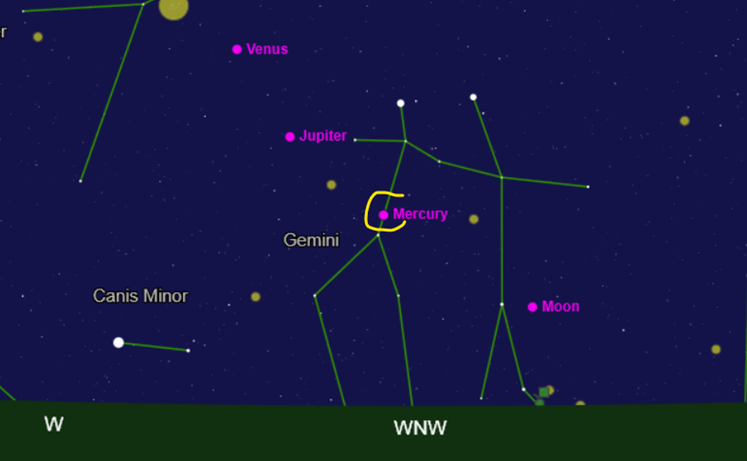
Trying to keep up with the comings and goings of Mercury is dizzying. One minute it’s rising and falling in our early eastern morning skies, and then the next that the swift winged-footed messenger of the gods is visible now in the western sky at sunset.
In fact, the ancients thought they were seeing two different stars, one in the morning and a different star in the evening. It wasn’t until circa 350 BCE that it was realized the two stars were indeed one. Before that time the Babylonians called Mercury “Nabu”; the ancients in China called it the “Hour Star”; and the Maya saw it as an owl serving as a messenger to the underworld. Interestingly, the common themes regarding Mercury, which span time and cultures are those of messages and speed. Hum.
Mostly elusive. Yet this June, due to its proximity to our Sun, it is usually brighter and higher in our western sky at sunset. And you ask, “Why is that?”
Time for science. Mercury’s orbit around the Sun is unique. Its orbit is described as “highly eccentric” as egg-shaped. Consequently, the planet’s distance from the Sun varies significantly, and it is this variation that has Mercury significantly higher in the evening or morning skies, than other times. Next, Mercury is currently at its greatest eastern elongation. Simply put, this means Mercury is at its greatest apparent separation / distance from the Sun. For us on Earth, Mercury is furthest out of the Sun’s glare making it the best time to experience our most diminutive of the five visible planets.
On the 15th, Mercury reaches a rare whopping peak altitude of 17 degrees above the western horizon after sunset. Shining at a magnitude of 0.4 and 49% illumination. For comparison, Jupiter is shining at a magnitude of -1.9.
Speaking of Jupiter, its prominence in the western sky is joined by the planet Venus (magnitude -4.0) making finding our elusive and diminutive first planet Mercury, easy. Draw an imaginary line down from Venus to Jupiter. Extend that line down towards the horizon and the next bright pin prick of light you’ll see Mercury. But you better be quick about it, you’ll have about 25-minutes to it. Grab your binoculars to view Mercury as you can use it to cut out some of the Sun’s glow.
Quite a Gather. The Beehive, the Moon, Mercury, Venus, Jupiter, Pollux, Castor, and Procyon, June 17th

I mentioned it in the introduction, there’s mucho happenings above the western horizon in the middle of June, and I’m not lying when I say it’s gonna be a grand gathering of stars, planets, one very special open cluster.
To join the gathering, follow the same directions as above when we discussed locating Mercury. The difference is this time is the arrival of the 2-day old crescent Moon, now between Jupiter and Mercury. Adding to the mix are the two bright stars to the west (your right) of Jupiter, Castor and Pollux, the heads of the brothers in the constellation Gemini. Pollux is the yellowish orange color and closest to Jupiter. Castor is a distinct blue-white. Draw an imaginary line down towards the horizon from Pollux, through the planet Mercury and then the next brightest point of light is the star Procyon. Alpha star for the constellation Canis Minor.
To find the Beehive Cluster, a simply magnificent open star cluster in the constellation Cancer, return to Jupiter and draw an imaginary line up to Venus, and then continue the line half the distance between Jupiter and Venus. There, look for a fuzzy patch of pin pricks of light. Give your eyes time to relax, and then slowly look back at Venus, and in the periphery of your vision the cluster will “pop” into view. You’ll be surprised and amazed.
Don’t fret, if you’re busy or it’s cloudy on the 17th, the group will hang out for a few nights. You know, it’s been some time since the gang's been together. They’ve got a lot of catching up to do.
The Summer Solstice, June 21st

The Summer Solstice in the Northern Hemisphere (North America, Europe, most of Asia, Northern Africa) arrives in the Rocky Mountain Region on June 21, at 2:27am.
The word “solstice” comes from the combination of two Latin words, “sol” (the Sun) and “sistere” (to stand still). On the 20th, in the northern hemisphere, this appears to happen as the Sun, close to 90 degrees north of the horizon. At that time the Sun is directly overhead, and crosses the Tropic of Cancer. Interestingly, the Sun seems to be in the same location in the sky, the day before the solstice, and then the day after the solstice. At the time of the solstice for those living on the Tropic of Cancer, the Sun does indeed appear to stand still directly overhead.
And it’s all because of the Earth’s tilt and orbit around the Sun. The consequence of our orbit and tilt is that the Sun reaches its northernmost path in the sky. At the solstice, Earth’s North Pole is at its maximum tilt to the Sun, approximately 23.4 degrees, which is why the Solstice is the longest day of the year. We can expect roughly 16 hours of daylight on the day of the Summer Solstice.
For those residing in or near the Arctic Circle, the party never ends – I mean the Sun never sets. Sadly, after that date the Sun begins its long sojourn south, and hence the daytime shortens. But, we don’t need to concern ourselves with that now because it’s summer.
Don’t Look Up! International Asteroid Day, June 30th

My hunch is you’ve never heard of International Asteroid Day. It commemorates a real asteroid catastrophe. On June 30, 1908, the Tunguska event occurred over Podkamennaya, Siberia, over the Russian Tunguska River. That event squashed approximately 80 million trees and annihilated nearly 1242 square miles of forest. The explosion was estimated to be between 3- 50 megatons of TNT. And all of this from a rock (an asteroid or meteor) that never hit the ground. Let that swirl around in your brain for a second as you attempt to comprehend the extent of the damage from a rock that never even hit the ground.
So what happens when a rock star, an Apollo 9 astronaut, a filmmaker, and a planetary nonprofit president come together on June 30, 2015?
Say what and who? That’s right, this esteemed group is made up of the lead guitarist from the rock group Queen, Brian May; (Who just happened to have a degree in astrophysics from Imperial College London, and by that way, that’s Sir Brian May, mind you.) astronaut Rusty Schweickart, Grig Richters, and Danica Remy. Not your typical team.
Well, they must have done something right because In December, 2016, the United Nations made it official when the General Assembly adopted resolution A/RES/71/90, declaring June 30, International Asteroid Day. This was done to raise public awareness about the asteroid impact hazard and to inform the public about crisis communication actions in case of a credible near-Earth object threat.
Let’s work the math. With over one million asteroids in space that could potentially strike Earth, with a 1% chance that a big rock could hit our home planet. Okay, what does that come to? By the way, most scientists who worry about this type of cataclysmic collision tell us that we’ve just identified around 1% of all the comets, meteors, and asteroids whizzing around out there. They’re sounding the alarm and stating the need for mankind to increase our discovery rates to 100,000 objects per year within a decade.
Don’t think it can happen again? Think back to 2013, when a small asteroid exploded over Chelyabinsk in western Siberia. There were no deaths from the impact yet plenty of injuries were documented from the consequences of the blast.
Be forewarned, the 1908 Tunguska wasn't a cosmic fluke. It can happen again.
Do look up!
So sway away fellow stargazers, be it in your terra firma hammock or a nocturnal chaise lounge. Get outside on the Summer Solstice. The day and night of June 21st is significant for many reasons, and in many cultures. It is recognized around the world through rituals and festivals. Ergo, all the more reason for you to have a picnic, float on a lake, fly a kite, or lay in the grass sifting its dense blades between your toes. Now, that’s living.
Then, after a day like that, now it’s time to relax and greet the night. Tilt your head back and look up to enjoy the wonders of the universe. Blend your longest day of the year into a summer night under the celestial sphere. It’s June. Summer is here. Dive into the cosmos, Get wet.
Clear skies to you!


Comments