
What's Up Above? January Stargazing
Winter is here. Notwithstanding the fact that since the passing of the winter solstice in late December, and the indiscriminate increasing length of daylight, by approximately one minute per day, the northern hemisphere days remain short with nights that stay deep and long.
The chilly irony of winter is that while the months of January, February, and March are mind-numbingly cold at night, spectacular gems, gorgeous celestial events, and unique colorful objects beckon you to come out and view them. Darkness arrives earlier, celestial objects are visible sooner, lower humidity in cold air lend to sparkling, clear, and inky black dark skies.
Now step outside, and look up. The father of the sky, Jupiter, remains in his throne at the top of the sky. As a predominant yellow, ivory, off white colored point of light, Jupiter’s sovereignty is luminous. A flood light shining. Our fifth planet from the Sun now traverses the night sky from east to west throughout the night. Drop straight down from Jupiter towards the horizon, and there awaits an enchanting twinkling blue gem. The star Sirius, the brightest star in our northern winter sky.
What else is there to see in our January night sky, besides Jupiter? Is that a trick question? Yea, it is. There are two meteor showers. The Full Wolf Moon arrives early this month. While a Moon and Saturn conjunction make it easy to locate our shy blue Neptune in the night sky.
Stargazing is a year round activity; so bundle up, get outside, and look up. A clear, dark, starry January night beckons.
Quadrantids Meteor Shower Peak: January 3rd

The annual Quadrantids meteor shower began in mid-December and showers through mid-January. The meteor shower reaches its peak ZHR (zenithal hourly rate) on January 3rd. Some 500 years ago, Chinese, Japanese, and Korean astronomers observed comet C/1490 Y1. It is thought that this comet is responsible for the trailing debris stream that the Earth passes through resulting in the meteors we see today.
Your chance of seeing meteors from the Quadrantids’ is better whenever the constellation Bootes is above the horizon. This means that there are two shows of the Quadrantids showers each night; an early matinee, and then a late, late show. Specifically, the Quadrantids matinee has the radiant point above western sky from dusk till approximately 7:00pm, after that the radiant point falls below the northwestern horizon. It is anticipated that 6pm will be the peak time to look for meteors. Recall that the radiant point is the area from where most of the meteors will originate. Then, approximately four hours later, around 11pm, the radiant point rises up over the north northeast horizon again at 11pm. As it continues to rise into the new day of January 4rd, it reaches a peak altitude of 70 degrees above the horizon in the predawn night sky. At that time it is estimated the ZHR to be approximately 112 meteors per hour.
Not all meteor showers are equal. The Quadrantids are fainter than most showers, so keep a sharp eye out in the area of the radiant point. Remember to scan the entire sky for meteor flashes, steaks, streamers, and bombs. Don’t want to be a kill joy but our Solar System’s street light, the Moon will be the Full Wolf Moon, fully illuminating the night sky. Sadly, the fainter meteors inherent to the Quadrantids meteor shower will be washed out by moonlight. Don’t despair. The Full Moon will be in the southern part of the sky, while the Quadrantids will be in the northern section of the sky. Keep the faith.
First Full Moon of the Year: January 3rd
The first Full Moon of 2026 peaks at 3:02am on the 3rd and is commonly referred to as the full Wolf Moon, named after howling wolves. This full Moon is also called the “Moon After Yule '' in the Anglo-Saxon culture as it is the first Full Moon to follow the winter solstice festivals. In Celtic and Old English lore, the first Full Moon of the year is also referred to as the Quiet Moon, and the Stay Home Moon. (That makes sense.) Some North American indigenous cultures reference it as the Severe Moon or Center Moon. Prior to time being measured in the solar year of 12-months, time was tracked by the seasons, and consequently the lunar months. Today we use many of these month’s names as the names of Full Moons.
Oh, and do wolves really howl at the Moon? Here’s a factoid. Wolves howl in the direction of the Moon to project their howl upward so as to carry their sound farther and in doing so, mark their territory.
Earth at Perihelion, January 3rd

Perihelion is the point in the Earth's orbit when it is closest to the Sun. It’s an annual occurrence. This year the Earth will reach perihelion on January 3rd. At that moment, the Earth will be approximately 91,403,637 miles from the Sun. (For reference, the average Earth–Sun distance is 92.96 million miles, and the farthest point is about 94.5 million miles.)
Here’s a fun fact. The Earth’s nearest or farness from the Sun does not cause the seasons. The Earth’s tiled axis of 23.5 degrees primarily determines the seasons. When the North Pole and consequently the Northern Hemisphere is tilted away from the Sun, we get winter, no matter the distance between the Earth and the Sun.
Want more? The Earth moves faster in its orbit at perihelion, traveling at nearly 19 miles per second. On the 3rd, the Sun will appear “marginally” larger in the sky. And the Earth receives about 7% more solar energy at perihelion when compared to when it is at its farthest point, aphelion.
The King of the Sky is King: Jupiter at Perigee and Opposition, January 9th and 10th
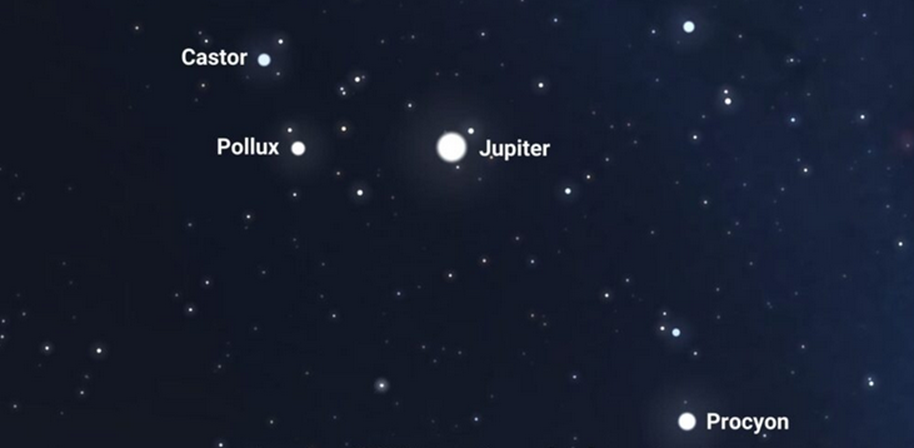
“The Object in the mirror is closer than it may appear” holds true this month. It is more than just a solar system warning stenciled on the bottom of your starship's right side, outside, rear view mirror. This month Jupiter gets up close and personal with the Earth on the 9th, and then the next day positions itself to shine luminously upon it.
When Jupiter swings by the Earth as it orbits the Sun on the 9th, our distance from Jupiter will be roughly 392,000,000 miles. That moment is called perigee. Conversely, at its greatest distance, apogee, the Earth – Jupiter separation is around 577,000,000 miles. The average separation is 484,000,000 miles. Fun facts.
Moreover, when Jupiter reaches perigee, as it passes the Earth, a straight line alignment takes place between the Sun, the Earth, and Jupiter. Key here is that Earth is in the middle. Consequently, this configuration is called opposition which is when the Sun and Jupiter are on exactly opposite sides of the celestial dome. At opposition Jupiter reaches its maximum altitude, achieves maximum size, and is at maximum magnitude (brightness).
Even at its closest approach to Earth, it is quite difficult to distinguish Jupiter as more than a star-light point of light. The key is in the color. Jupiter appears off white or ivory colored while the surrounding stars are noticeably whiter. The beauty of the planet comes to life when you look through binoculars. Look for the equatorial storm bands and the Galilean Moons and watch how they change positions throughout the night.
When the King of the Olympian gods calls you forward for an audience in the grand hall of the night, you best be showing up.
Y-Ursae Minorid Meteor Shower Peak: January 19th
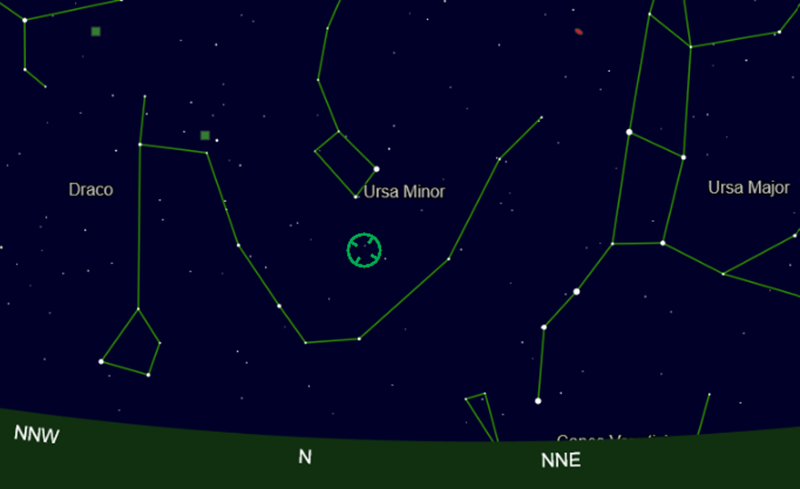
While the annual Quadrantids meteor shower began in mid-December and the showers continues into the beginning of January, the y-Ursae are correctly the first meteor shower of the year. The y-Ursae shower runs from January 15th through January 25th, peaking this year on the 19th during daylight hours. Even if you could see it at its peak, the y-Ursae Minorid meteor shower isn't the most prolific in our index of our annual meteor showers. On average you’ll see about three meteors per hour under dark skies when the radiant point is at its highest altitude of 67 degrees is reached above the northern horizon. The above image shows this point at 10pm local time.
If you have fortitude and a willingness to stave off the bitter cold of a January night, take heart your courage is rewarded. Good fortune will smile upon you that night since this year the y-Ursae meteor shower arrives when the Moon is one day past the New Moon ushering in an almost completely dark night. This will help you see fainter meteors. And since this is a circumpolar meteor shower, the radiant point never falls below the horizon, making the shower visible all night long. Here is a tidbit for you. The small bits of comet debris (most the size of a grain of rice) are estimated to be traveling nearly 76,000 miles per hour when they hit the Earth’s atmosphere and burn up between 60 to 100 miles above us.
A Friendly Conjunction of Neptune, Saturn and the Moon, January 23th

This evening’s line is the Moon, Neptune, and Saturn, creating a vertical arrangement 3.5 degrees total, top to bottom. That’s about a three-finger width when you extend your arm and hold your hand up against the night sky. For an alignment to be called a conjunction the objects must be within 5 degrees sharing the same celestial longitude as seen from Earth. Even better, this conjunction arrangement makes it much easier for you to find the elusive Roman god of the sea; or Poseidon, the god of the sea and earthquakes in Greek mythology.
Locating Neptune is easy, but you’ll need binoculars to find it and then enjoy its methane absorbing effect. Begin with locating the waxing crescent Moon, a youthful 5-days old, and from the bottom of the crescent’s tips, you’ll see Saturn about one closed fist’s width below it. You’ll see a point of light that appears pale yellow to golden in color, with limited twinkling compared to other stars around it. Now pull up your binoculars and slowly work your way back up to the Moon looking for a noticeable blue-hued prick of light. None of the surrounding stars will have a similar hue. That’s Neptune.
Oh, and that blue hue, it’s the result of the planet’s atmospheric composition and how it absorbs sunlight. Neptune’s upper atmosphere contains methane gas which absorbs red light from the Sun and reflects blue light. Catching a glimpse of our outer solar system’s ice giants is not easy so when you get the moments to see Neptune or Uranus, you want to take it. Good luck!
Traditionally January is a quiet stargazing month. Thank goodness. Damn it’s cold at night. It’s a challenge for even the hardiest of stargazers to step outside and look up, for any length of time. It takes real commitment and thoughtful preparation. So what’s to motivate you to stargaze this month? Let me count the ways: there’s two meteor showers; Jupiter at perigee and conjunction; and, a fresh crescent Moon pointing the way to Neptune, and there’s even some Earthshine bouncing back to your smiling face. That’s nothing to sneeze at, unless you have a head cold.
Make a date with the night sky. Write it on your calendar. Carve out a little time to get out into the night, get cold, and get inspired by the beauty, mystery, and synchronicity of our solar system and the universe overhead. I guarantee you that if you step outside for five minutes, you’ll stay out looking up for 10 minutes at the planet Jupiter dominating the night sky in brilliance and boldness throughout January. Might be a good time for you to schedule a personal audience with the king of the sky. Jupiter awaits.
Clear skies to you!


Comments