
What's Up Above? April Stargazing
George Harrison wrote prophetically, “little darling, it’s been a long cold lonely winter.” For some, spring announces and marks the end of loneliness and the arrival of cherry blossoms, tulips and crocus extended green thumbs, all heralding a season of renewal and rebirth. Winter is over. Yet, for us folks living in the high country, spring is still a hope, a season far off in the distance. It’s a feeling, or a sense that spring is “out there” one just doesn’t know when it will arrive. A memory of snow on the first day of summer some years back won’t fade. Indeed, the weather report foretells more snow is in the future.
Yes, hope, like spring, is eternal. The promise of spring remains to be fulfilled, as it is every year. Appropriately, our celestial dome in the month of April, plays its part in fulfilling this promise with the arrival of our first major meteor shower of the year. Then, we honor Gaia, the Greek goddess who presides over Earth, this Earth Day, with a morning planetary conjunction and an evening meteor shower. How fitting. One must trust the cosmos. Then, there is our cosmic messenger, Comet MAPS. It’s a sungrazer. Meaning, we’ll either see it with our naked eye at dusk, or it fizzles out and we see nothing.
It's April. It’s time for comets, conjunctions, a pink Moon, and a meteor shower. Are you curious? Well then step outside, and look up.
A Full Pink Moon and a Virgin Grain of Wheat, April 1th

Throughout history, a full Moon is notable. At times, it was a harbinger of both good and evil. It may surprise you that before clocks, time was marked by the passage of full Moons. For followers of the Catholic faith, the April full Moon is known as the Paschal Moon. The appearance of this full Moon establishes the date for Easter as the Sunday after the first full Moon of the month.
The Farmer’s Almanac refers to the April full Moon as the Pink Moon. The name is not due to the Moon taking on a pink hue color, however. Rather the name corresponds with the early springtime blooms of wild ground phlox, native to North America. This is because it is one of the first flowers to bloom in spring and has pink pedals. Specifically, for the Lakota, the April full Moon is called, “Moon When the Ducks Come Back.” For the Dakota Native Americans, it is “Moon When the Geese Lay Eggs.” Finally, for the Algonquin, it was the “Breaking Ice Moon.”
This month’s full Moon beauty is enhanced by the star Spica in the constellation Virgo. This binary star (two stars gravitationally bound) is the 20th brightest star in the night sky. When you view it through a telescope, because the two stars are so close together, Spica takes on a curious egg shape rather than the expected oval. Here’s a tidbit for you about Spica. Its name is derived from the Latin language spīca virginis. Which loosely translates to "the virgin's ear of wheat grain." The ancient Greeks believe that it was Spica the star that gave Hipparchus his insight to the precession of the equinoxes.
Catch Me If You Can. Comet C/2026 A1 MAPS, April 4 – 6th

Two of my favorite comet hunters have two aptly different ways of describing them. One with a beaming smile states brightly, “Comets make me happy.” The other, a bit more enigmatically, “comets are like cats, they all have tails and do whatever they want.”
This is how one must approach your quest to view our most recent cosmic visitor, Comet C/2026 A1 MAPS.
First, a few Comet MAPS details. The comet was discovered in January this year, by a team of astronomers operating a telescope in the Atacama Desert in Chile. The comet’s name is an acronym of the last names of the team members: Alain Maury, Georges Attard, Daniel Parrott, and Florian Signoret. Which is a bit different, though not rare, for a comet to be named after individuals. Most often a comet is named after the survey program through which it was discovered. Comet MAPS is a long-period comet. It likely came from the Oort Cloud, thus having an orbital period of thousands to millions of years.
C/2026 A1 Comet MAPS has an unusual path. It is following a path travelled by many predecessors all of which had Sun-grazing orbits. (This comet will either orbit or break up about 99,000 miles above the solar surface on the 4th.) The German astronomer Heinrich Kreutz, considered they were all pieces of a single humongous comet which broke up much earlier. Thus, C/2026 A1 Comet MAPS is called a Kreutz sungrazer comet. Of note, the Greek historian Ephorus reported seeing a large comet break to pieces in 371 BCE.
You are correct, a comet this close to the Sun, usually doesn’t survive the trip. Either MAPS will become far more brilliant than anticipated, or fizzle out. Now, that, to me, is what makes comets like cats.
Here’s how you can view Comet MAPS. Just after sunset, about 7:15pm local time, look west to the spot where the Sun just passed below the horizon. Above and to the south (left) there is the brilliant planet, Venus. Two finger widths below Venus, there you’ll see the comet’s fuzzy coma and faint tail. You’ll have about 40-minutes to view the comet before it slides below the horizon.
The comet is best viewed with your naked eye is between April 4th - 6th, with the pick night being April 5th. This is represented in the image above. If you have a pair of binoculars, grab ‘em. They’ll be a big help. Good luck and happy comet hunting!
A Crescent Moon, Venus, and Pleiades, April 19th

On the evening of April 19, just after sunset at 7:41pm local time, a quiet gathering unfolds in the western sky. Two days past the New Moon, a thin slender crescent Moon hangs low. Directly below it is the brilliant Evening Star, Venus, white bright. In between the two is my favorite, the delicate open star cluster known as the Pleiades, the Seven Sisters, cloaked in a haze of ancient blue light.
In mythology, each has a unique story to tell. For the Greeks, the Seven Sisters were pursued across the heavens by Orion, the hunter. To end the madness, Zeus transformed the sisters into stars, forever bound together. Venus, named for the Roman goddess of love, prosperity, and beauty is the luminous threshold between day and night. And the crescent Luna, the Roman goddess of the Moon evokes a phase of motion, and transition rather than fullness.
Seen together, this is more than a visual alignment—it’s a rare gathering of female archetypes in the night sky. The Sisters stand as a unit: independence, loyalty, and shared fate. Venus brings allure, presence, and a kind of unapologetic brightness. The crescent Moon, moving between phases, carries the quieter strength of return. They’re different expressions of the same enduring symbols of the feminine; briefly sharing the same slice of the night.
Begin Your Earth Day Celebration with a Planetary Conjunction, April 22th
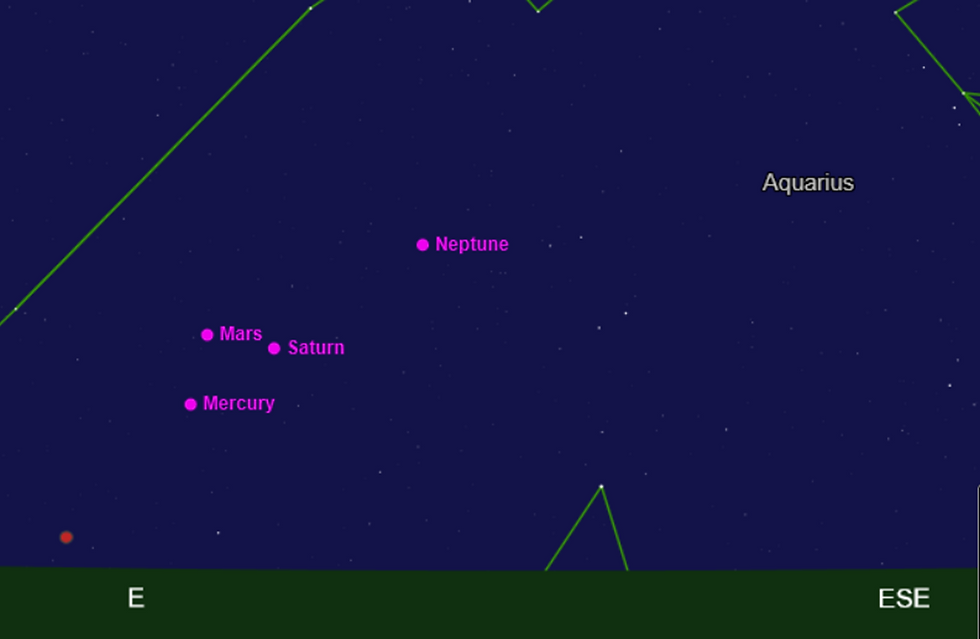
Greeting the day. Who doesn’t feel renewed watching a sunrise proclaim the arrival of a new day? The early morning Risers among us know this well. Would you believe there are those who believe that essentially, a sunrise and a sunset are the same thing, just at different times of the day? Really? Some will strongly beg to differ. For me, a sunrise puts a smile on my face, and there’s no better way to begin the day. And when the solar system smiles back, well you know you’re something special, a child of the cosmos. And this feeling is multiplied tenfold when it happens at the start of Earth Day, 2026!
Get up and go early on the morning of the 22nd and look east before sunrise. The image above shows the morning sky at 6pm local time, just before the Sun peeks over the horizon. There, my cosmically connected friend, you will feel the warmth of a universe smiling upon you.
First you’ll see Mars. It glows in a soft, reddish-orange color. Below it, hugging the eastern horizon is our speedy most inferior planet, Mercury, as a faint peach or minor pinkish-white. To the south of Mars (the right as you view it) is a muted gold, or soft yellowish point of light. That’s Saturn. The trio will be in a cluster with Mercury being the most challenging to locate because it can be a bit washed out by the approaching sunrise.
Greet the planets with a cup of coffee. I’m confident it will make you smile. Then, let your Earth Day begin.
End Your Earth Day Celebration with the Lyrid Meteor Shower, April 22nd
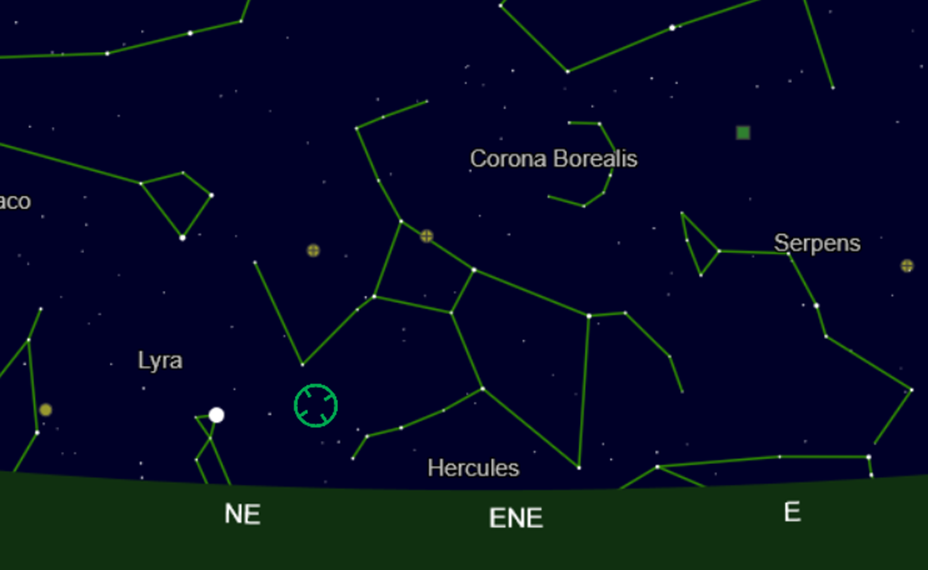
Can there be a better way to celebrate the conclusion of Earth Day than to have our cosmos honor Gaia, the Greek goddess who presides over Earth, by igniting by lighting up that night’s sky the first major meteor shower of the year? One way you can show gratitude for the terra firma we call home is by looking up and observing an evening to morning meteor shower raining upon it.
Usually the name of the meteor shower indicates the constellation from which the meteors will radiate. For the Lyrids, that’s misleading as the meteors will radiate from the constellation Hercules, neighbor to the constellation Lyra. This is a meteor shower made for the late nighters amongst us.
The shower becomes visible at 9:15pm rising above the northeastern horizon. It’s easy to find as Vega, the fifth-brightest star in the night sky, is right next door. That’s the point from where the meteors will radiate. This point will then arch around the celestial North Pole during the night and at 6am, it is high in the west sky. The current estimates indicate that the shower will produce its best display at day break, with approximately 10 – 25 shooting stars per hour. That’s good since it is one-day before the Moon’s First Quarter and it will have set by the time of the peak on the 23rd. The downer is the evening and night of the 22nd, moonlight will wash out the dimmer meteors.
The Lyrids aren’t the largest meteor swarm, but they’re worth checking out. So wrap up your Earth Day by looking up and appreciating the Lyrid meteor shower. And then, look down and appreciate the Earth we stand on and the universe surrounding it. Gaia and you both deserve it.
Whether April brings a breath of freshness and hope, or the ceaseless weight of winter, step outside into the night, and look up. Find renewal, solace, and hope in the transitioning of our celestial seasons.
As the Sun continues its rising in the daytime sky, we celebrate its return. Harrison was correct, we too, like the Sun climb and rise out of a long cold lonely winter. We are refreshed, and renewed. While we exclaim, “Here comes the Sun!” don’t forget to look up at the stars and planets this month. They’ve been there all along with you, through a long cold lonely winter.
Clear skies!


Comments